 Ultimate guide
How to Choose a Martial Arts Gym for Kids
Last Updated: November 14, 2026
Quick Summary
Evaluate a martial arts gym for kids by watching a real class, meeting the instructor, and asking direct questions about safety, curriculum, and cost. Start with your child's temperament rather than the style, and treat the trial class as a two-way audit of how the coach handles a mixed-ability group.
- Ask whether your child wants contact or distance, and whether they respond to structure or play.
- Readiness is behavioral: a child who stays in a group for thirty minutes and accepts correction is ready.
- Run a safety checklist covering mat condition, supervision sightlines, and gradual contact.
- Ask for the total first-year cost, including uniform, belt fees, and registration.
- Walk away from gyms that pressure you to sign on the spot or hide pricing.
Table of Contents
- Start With Your Child, Not the Style
- The Best Martial Arts for Kids: Comparing Karate, Taekwondo, Judo, BJJ and Muay Thai
- The Right Age for Kids to Start Martial Arts
- How to Evaluate a Martial Arts Gym Before You Enroll
- Martial Arts Gym Safety for Kids: A Parent's Observation Checklist
- Questions to Ask a Martial Arts Instructor Before Signing Up
- Costs, Contracts and What a Trial Class Should Show You
- Red Flags, Accessibility and Family Logistics
- Book Your Child's Free Trial Class at Evolve Jiu Jitsu & Muay Thai
- Frequently Asked Questions
Start With Your Child, Not the Style
Most parents begin the search for a martial arts gym for kids by asking which style is best. That is the wrong first question. The better starting point is your child: their temperament, their energy level, how they handle losing, and what they actually want out of it.
A shy seven-year-old who freezes in crowds needs a different entry point than a nine-year-old who wrestles siblings on the living room floor. In a well-run kids class, both types can settle in, and the difference is rarely the style. It is the fit between the child and the room.
Ask three questions before you look at a single school:
- Does your child want contact or prefer distance?
- Do they respond better to structure and ceremony or to movement and play?
- What outcome matters most to you: confidence, focus, fitness, or self-defense?
Parents who want to see what kids actually gain from training can read about the confidence and resilience jiu jitsu builds in children. Families focused on attention and self-control will find how martial arts develops focus and discipline useful before visiting any gym.
The Best Martial Arts for Kids: Comparing Karate, Taekwondo, Judo, BJJ and Muay Thai
The best martial art for a child is generally the one that matches their temperament and the gym's teaching quality. Each style below trains different physical and mental muscles.
| Style | Contact Level | Best For | Watch For |
|---|---|---|---|
| Karate | Light to moderate | Structure, respect, focus | Varies widely by school |
| Taekwondo | Light, kicking-focused | Fast movement, flexibility | Competition-heavy programs |
| Judo | Moderate, grappling and throws | Confidence through control | Falling practice is essential |
| Brazilian jiu-jitsu | Moderate, ground grappling | Problem-solving, calm under pressure | Sparring intensity varies |
| Muay Thai | Moderate to higher, striking | Fitness, striking skill | Head contact rules matter |
Karate and taekwondo lean on forms and repetition, which suits kids who like clear structure. Judo and Brazilian jiu-jitsu teach children to control another person without striking, and both reward patience and use over size. Muay Thai is the most striking-focused option and tends to attract high-energy kids, though parents should ask directly about head-contact rules and protective equipment.
If you are weighing the two styles we teach side by side, this comparison of jiu jitsu and Muay Thai for children breaks down the trade-offs in more detail.
The Right Age for Kids to Start Martial Arts
Readiness is behavioral, not a birthday. A child who can stay in a group for thirty minutes and accept a correction without melting down is ready enough to try.
Younger children benefit from short, game-based classes with lots of movement and frequent water breaks. Older children can handle longer sessions, more technical instruction, and light sparring. There is no age at which a child is "too late" to start.
If you are unsure whether your four-year-old is ready, four signs your child is ready for martial arts walks through what to look for at home before you book anything.
How to Evaluate a Martial Arts Gym Before You Enroll
Evaluate a martial arts gym by watching a real class, meeting the instructor, and asking direct questions about safety, curriculum, and cost.
Instructors: Teaching Experience With Children
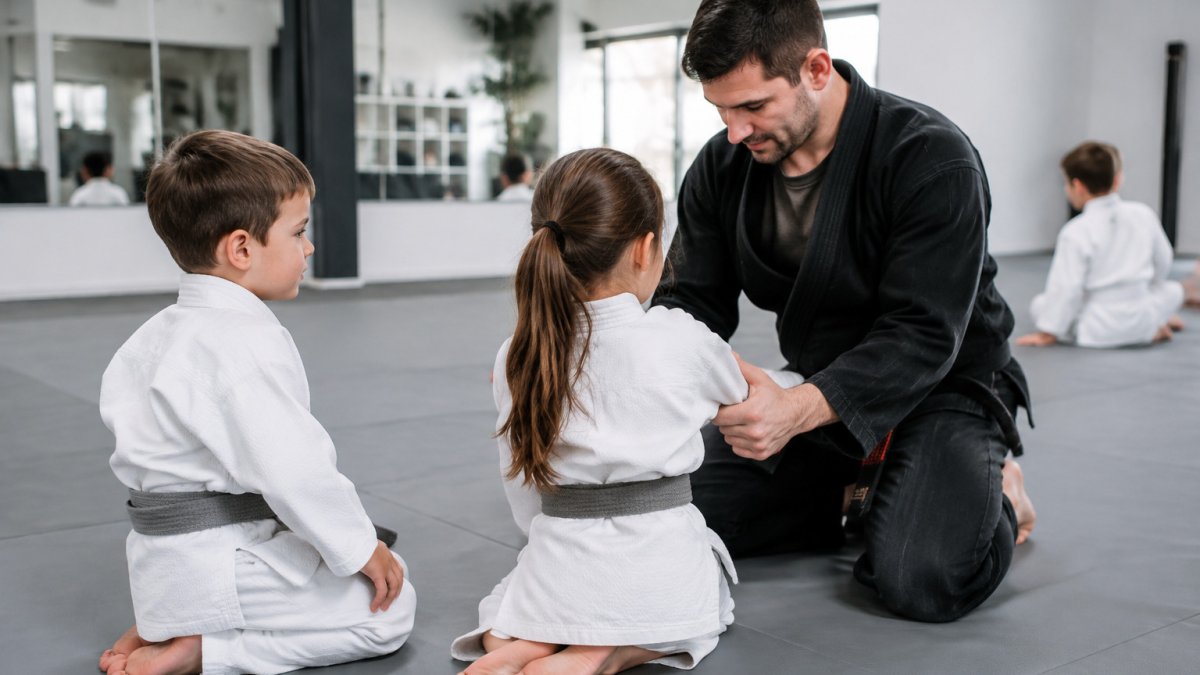
Teaching experience with children matters a great deal for a good experience. A decorated competitor is not automatically a good kids' coach. Look for an instructor who gives corrections calmly, uses names, and keeps every child engaged rather than drilling the front row.
Ask how long the coach has worked with children specifically, not just how long they have trained. Watch how they handle the child who drifts off task or the one who is struggling. Patience under mild chaos is the tell.
Class Structure, Size and Curriculum
A well-run kids class has a predictable rhythm: warm-up, technique, practice, and a short game or cool-down. Structure helps children feel safe, and safety is what lets them take risks.
Ask about class size and the ratio of instructors to students. Smaller groups mean more individual correction. Ask whether the gym follows a structured curriculum with clear levels, so your child knows what they are working toward and you can see progress without relying on belt promotions alone.
Martial Arts Gym Safety for Kids: A Parent's Observation Checklist
Safety at a martial arts gym for kids comes down to supervision, mat condition, and how contact is introduced. You can verify all three in one visit.
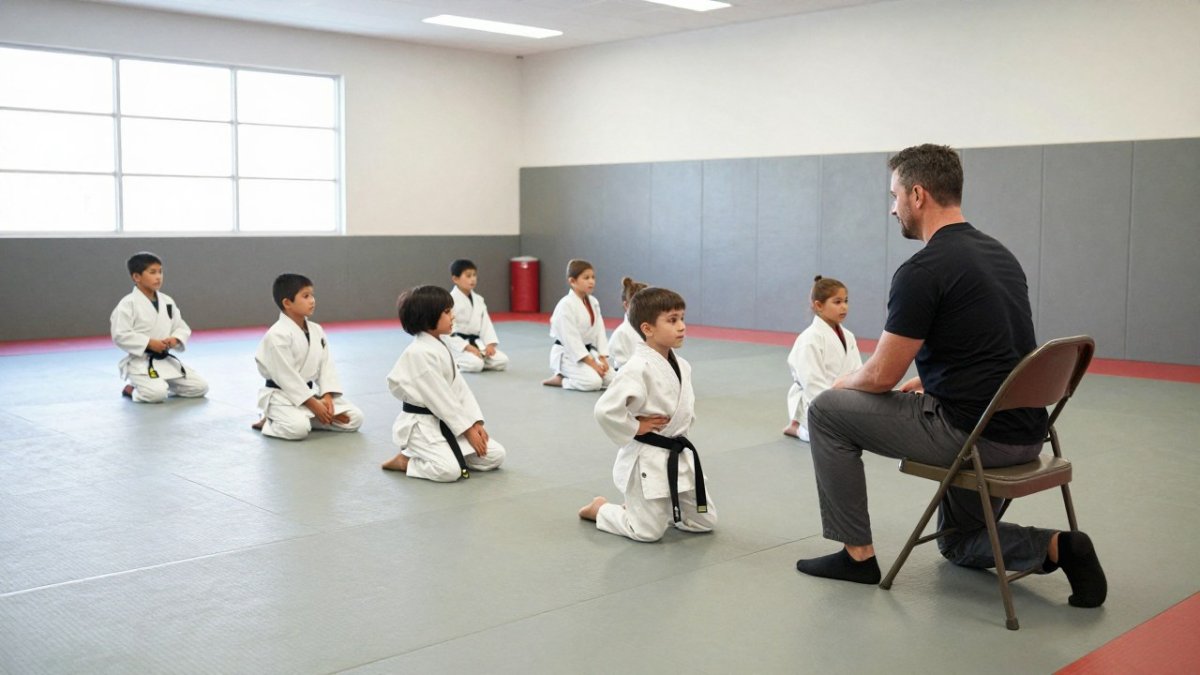
Run this checklist during your observation class:
- Mats are clean, intact, and properly joined with no gaps or tears
- At least one instructor is positioned to see the whole room at all times
- Children are grouped by size and age, not mixed indiscriminately
- Protective equipment is required and actually worn during contact drills
- Contact is introduced gradually, with clear rules and controlled intensity
- The training space is free of exposed hardware, clutter, and trip hazards
- Bathrooms and exits are visible and unobstructed
Watch out: a gym that lets new children spar hard on day one is a gym that has not thought carefully about injury prevention. Beginners should spend weeks on technique and controlled drills before any live contact.
Questions to Ask a Martial Arts Instructor Before Signing Up
Ask about teaching background, class ratios, contact rules, and how progress is measured. The answers matter more than the credentials on the wall.
Bring this list to your visit:
- How long have you taught children this age?
- What is the instructor-to-student ratio in a typical class?
- How do you introduce sparring, and is it optional?
- What does a beginner's first month look like?
- How do you measure progress beyond belt rank?
- What happens if my child has a bad day or wants to quit?
- How do you handle a child who is disruptive or overwhelmed?
The answer to question six can tell you a good deal. A coach with a real plan for flagging motivation, rather than a shrug, is more likely to understand child development in practice.
Costs, Contracts and What a Trial Class Should Show You
Membership pricing depends on the program, the number of weekly classes, and the length of commitment, so ask for the full fee schedule before you enroll. Check Evolve Jiu Jitsu & Muay Thai's website for current pricing or to request a quote. The number that matters is not the advertised monthly rate; it is the total cost of the first year, including everything the gym requires you to buy or pay before your child steps on the mat.
Build that number yourself by asking for each line item:
- Monthly tuition. Ask whether the rate is per child, per program, or per number of weekly classes, and whether it changes when your child moves up a level.
- Enrollment or registration fee. Often charged once at sign-up and sometimes again if a membership lapses and restarts.
- Uniform and equipment. A gi, belt, rash guard, shin guards, gloves, and a mouthguard are common requirements. Ask which items the gym sells, which it allows you to buy elsewhere, and whether loaner gear is available for beginners.
- Testing, promotion, or belt fees. Some schools charge separately for each belt promotion or rank test; others fold it into tuition. Ask for the schedule.
- Tournament, seminar, and camp fees. These are usually optional, but a competition-focused program may expect regular participation.
- Family and multi-child discounts. Ask how the discount is calculated and whether it applies to the second child's full rate or only to a portion.
Contract terms deserve the same scrutiny as the price, so ask each gym to explain its commitment length and cancellation rules in writing. Ask three questions about any contract: How long is the initial term? What exactly triggers a cancellation fee, and how is it calculated? Is there a written freeze or medical-pause policy if your child is injured or your family moves?
Watch out for contracts that auto-renew for a full new term unless you opt out within a narrow window. Get the cancellation and renewal language in writing before you sign, and keep a copy.
A trial class should show you the real class, not a showcase. Evolve Jiu Jitsu & Muay Thai offers a free first class. You want to see how the coach handles a mixed-ability group, how your child reacts to the room, and whether the other families seem like people you would spend Saturday mornings with. Treat the trial as a two-way audit: watch whether the instructor corrects the children who are struggling, not just the ones in front, and notice whether your child is given a name and a place in the group within the first ten minutes. Ask at the end what the next step costs and what the gym expects you to commit to, and see whether the answer is clear and unhurried. A gym that is comfortable letting you walk out without signing anything is usually a gym that is comfortable with its own program.
Red Flags, Accessibility and Family Logistics
Walk away from any gym that pressures you to sign on the spot, hides its pricing, or cannot explain its safety rules. Those three signals predict problems better than anything else. Beyond them, the most useful red flags are observable during a single visit rather than buried in a policy document.
Safeguarding and discipline red flags. Watch how instructors correct behavior. A coach who shames, singles out, or physically yanks a child to get compliance is teaching children that power is the answer. Ask whether the gym has a written conduct policy for staff and students, whether instructors are background-checked, and whether there is a clear rule about one-on-one time with a child out of sight of other adults. A gym that cannot describe its safeguarding policy in plain language, or that treats the question as an insult, has not thought about it.
Accessibility and individual needs. Ask directly whether the gym can accommodate a child with sensory sensitivities, a physical limitation, anxiety, ADHD, or an individualized education plan. A useful answer is specific: a quieter warm-up corner, a heads-up before the whistle, a visual schedule, a slower introduction to contact, or a coach who will pair a new child with a patient partner. A vague promise to "work with any child" is worth less than one concrete adjustment the coach can describe. If your child needs a slower start, ask whether the gym offers private introductory sessions or a smaller beginner group before joining the main class.
Family logistics. Class times that work around school and work, drive time, parking, and whether siblings can train at the same time decide whether attendance survives a busy season. Consistency beats prestige. Check the schedule against your actual week, not an ideal one: ask about make-up classes for missed sessions, whether parents can watch from inside the room or only through a window, and how the gym handles sibling drop-off and pick-up. Ask what happens on school holidays and whether the gym follows the local school calendar.
Measuring progress without pressure. Belt promotion is the most visible milestone, but it is a poor measure on its own. Ask how the gym gives feedback between promotions, whether children are tested on technique, attitude, or attendance, and how often promotions happen. A healthy program lets a child progress at their own pace and treats competition as optional. Watch out for a gym that promises a belt within a set number of months or pushes every child toward tournaments. The better question is what your child can do now that they could not do three months ago, and whether the coach can answer that with specifics.
Book Your Child's Free Trial Class at Evolve Jiu Jitsu & Muay Thai
The fastest way to answer "how to choose a martial arts gym for kids" is to see one in person. Reading helps, but watching your child step onto the mat is the clearest test.
At Evolve Jiu Jitsu & Muay Thai, our kids' program starts at age four and is led by Checkmat black belt Todd Aimer. Your child's first class is free, so you can see the coaching, the room, and the other families before you commit to anything. If you are ready to enroll, browse beginner-friendly class options and book a trial.
Choosing a gym is really a test of patience: visit more than one, watch a full class, and ask the questions most parents skip. Evolve Jiu Jitsu & Muay Thai makes that easy with a complimentary first class, instruction from a Checkmat black belt, and programs for children from age four through adults. Get started with Evolve Jiu Jitsu & Muay Thai and give your child a first class that shows you exactly what training here feels like.
Frequently Asked Questions
At what age can a child start martial arts?
Evolve Jiu Jitsu & Muay Thai accepts children from age 4. At that age the focus is movement, listening skills and following simple instructions rather than technique. Ages 4 to 6 usually suit short, game-based classes, while ages 7 to 12 handle structured drills and beginner sparring with protective equipment. Teens can join adult beginner classes. Watch a trial class to see whether your child can stay engaged for the full session before committing.
Is Taekwondo or Jiu-Jitsu better for kids?
It depends on what you want your child to get out of it. Taekwondo is striking-based with heavy emphasis on kicks, flexibility and belt progression, which suits kids who like fast, athletic movement. Brazilian jiu-jitsu is grappling-based, with less impact and more problem-solving, which suits kids who prefer close-contact strategy over speed. Visit a beginner class in each style and let your child try both before deciding.
What should parents look for in a martial arts gym for kids?
Check four things: an instructor with real experience teaching children, a class size small enough for individual correction, a structured curriculum with clear progression, and a clean facility with intact mats. Ask about supervision ratios during sparring and whether parents can watch classes. A gym that answers these questions directly and lets you observe a full session before enrolling is usually a good sign.
How can I tell if a martial arts class is safe for my child?
Watch a class and note the mat condition, how close the instructor stays during contact drills, and whether sparring is separated by size and experience. Protective equipment is worth looking for during any contact work, and beginners should ease into live sparring. Ask what the gym's injury protocol is and who administers first aid. A clean training space and calm, controlled drills matter more than how impressive the advanced students look.
How many times a week should a child practice martial arts?
Many families start with one or two classes per week, depending on the child's age and energy. Ask the instructor what frequency they recommend for beginners. Watch for signs of burnout, such as reluctance to attend, and scale back rather than pushing through.
Should parents watch their child's first martial arts class?
Yes. Watching lets you judge instructor patience, class control and how your child responds to the environment. It also gives you a chance to see the facility, mat condition and supervision during contact drills. Evolve Jiu Jitsu & Muay Thai offers a free first class, which is an easy way to observe without commitment. Ask afterward what your child liked and disliked, then decide together.