blog
Is Brazilian Jiu-Jitsu Good for Self-Defense? An Honest Look
Quick Summary
Yes, brazilian jiu-jitsu is one of the most practical grappling systems for one-on-one confrontations that go to the ground, since technique lets a smaller person control a larger opponent. It is not a complete self-defense system, though, and it does not handle multiple attackers, weapons, or unfamiliar environments well.
- Technique like use, positioning, and control matters more than strength on the mat.
- Escapes and sweeps from bad positions are as important as attacks.
- Multiple attackers can make a ground fight dangerous, so staying standing is key.
- Avoidance, escape, and de-escalation should come before any grappling.
- Beginners should expect years of consistent training to build real skill.
Table of Contents
- What Brazilian Jiu-Jitsu Does Well in a Real Confrontation
- Where BJJ Falls Short for Self-Defense
- BJJ vs. Boxing for Self-Defense: Which Handles Real Threats Better
- BJJ vs. Wrestling for Self-Defense: Overlap and Differences
- How Long It Takes to Learn BJJ for Self-Defense, and Beginner Techniques to Start With
- Booking Your Free First Class at Evolve Jiu Jitsu & Muay Thai
- Frequently Asked Questions
What Brazilian Jiu-Jitsu Does Well in a Real Confrontation
Last Updated: October 30, 2026

Is Brazilian jiu-jitsu good for self-defense? Yes, in one-on-one situations that go to the ground, it is one of the most practical grappling systems you can train.
Most of the value comes from technique. A smaller, lighter person can control a larger opponent through use, body position, and timing; strength helps but rarely decides a fight on the mat.
The skills that matter most in a real confrontation are simple to name:
- Keeping your base and not getting pinned flat
- Using hip movement and frames to create space
- Controlling an opponent's posture and limbs
Use, Positioning, and Control on the Ground
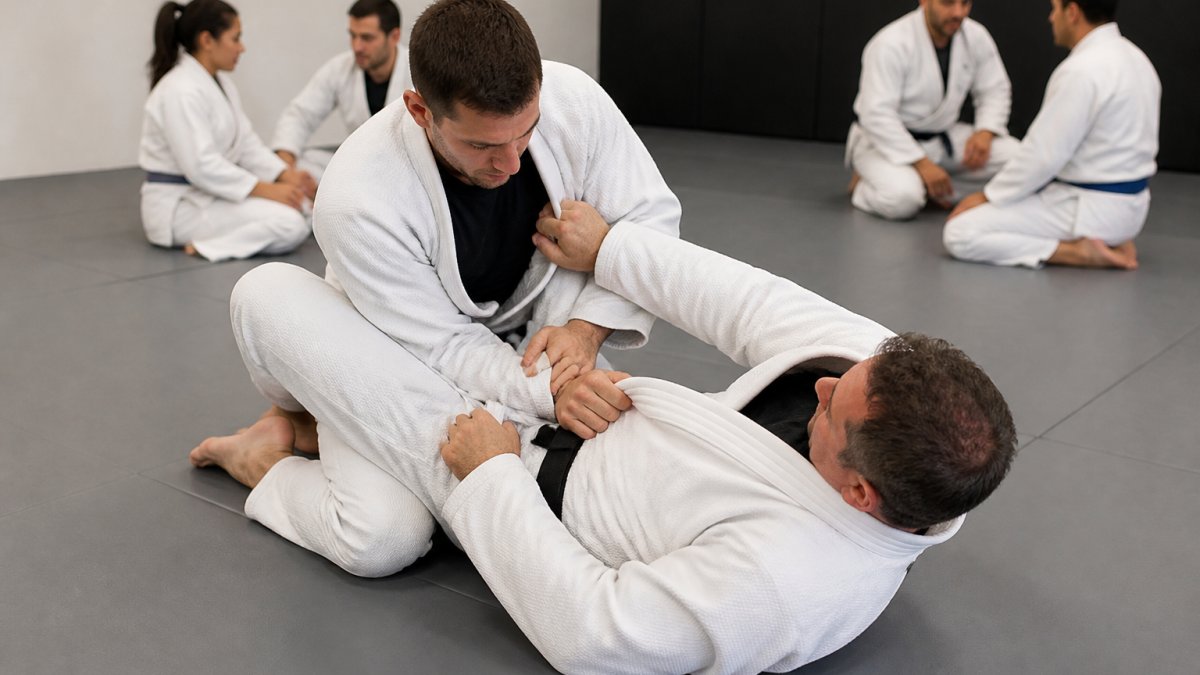
Use is the core idea. A strong arm pushing straight at a locked joint loses to a smaller person who moves the joint along its natural angle.
Control keeps an opponent from getting back up or reaching for something.
Watch out: control takes years to build under pressure. Beginners often hold positions too tightly and tire themselves out in a few minutes.
Escapes and Sweeps From Bad Positions
Escapes are as important as attacks. Being pinned in mount or side control is a common danger, and knowing how to bridge, shrimp, and create frames gives you a way out.
These moves are drilled over and over in class. For a deeper look at how instructors teach these fundamentals, see Brazilian jiu-jitsu technique overview.
Where BJJ Falls Short for Self-Defense
BJJ is not a complete self-defense system. Its training is built around one-on-one grappling with rules, a controlled pace, and a mat. Real threats can be sudden, multiple, and armed. The honest limitations fall into four buckets: other people, weapons, the environment, and the law.
Multiple attackers change the math
Ground fighting assumes one opponent. With a second person involved, the calculus flips: while you control one person on the mat, the other is free to kick, stomp, or grab a weapon. The general advice is to stay standing, keep your head on a swivel, and create distance rather than accept a ground fight.
Weapons and improvised threats
A knife, a bottle, or a firearm changes the risk completely. Grappling range is the worst place to be against an edged weapon because you cannot see both hands once you tie up. Avoidance and escape are commonly recommended first: run if you can, create distance, put barriers between you and the threat, and call for help.
The environment is not a mat
Gym floors are padded and flat; parking lots, stairs, curbs, and rooms full of furniture are not. A takedown that is safe in class can put your head on concrete. Walls and obstacles limit the space needed for sweeps and hip escapes, and hard surfaces raise the stakes of every fall. When you train, ask whether your school discusses how surface and space change the plan.
Standing skills and safe disengagement
Most real confrontations start on your feet, and getting safely to the ground, or avoiding it, is a separate skill many BJJ schools teach only lightly. Takedown defense, balance, striking awareness, and the ability to break away and leave are not automatic byproducts of ground training. Cross-training in a standup art or choosing a school with takedown-defense and disengagement drills closes this gap.
Legal and ethical limits on force
Using force is only justified when it is necessary to stop an immediate threat, and the rules vary depending on the situation and where you live. Proportionality matters: controlling or restraining someone is not the same as punishing them, and continuing to apply submissions after the threat ends can create legal exposure. Avoidance and de-escalation are generally emphasized first, verbal boundary-setting, leaving, calling for help, with grappling as a last resort.
Guidance on self-defense and the use of force from the National Institute of Justice
BJJ vs. Boxing for Self-Defense: Which Handles Real Threats Better
Boxing and BJJ solve different problems, so the useful question is which problems each one covers. Comparing them on consistent criteria, range, standing control, ground control, disengagement, training realism, and legal risk, gives a clearer answer than a pros-and-cons list.
A criteria-based comparison
| Criterion | Boxing | BJJ |
|---|---|---|
| Primary range | Striking distance | Clinch and ground |
| Standing control | Limited; relies on footwork and angles | Clinch, grips, and takedowns (if trained) |
| Ground control | Minimal | Core strength: pins, escapes, submissions |
| Disengagement | Strong, footwork and guard let you leave | Mixed, depends on standing and get-up training |
| Training realism | High-paced sparring, but rules limit clinch and ground | Resistance-based rolling, but rules limit strikes |
| Legal risk | Strikes can escalate force quickly | Control can look like restraint; submissions carry injury risk |
What boxing covers well
Boxing teaches distance management, footwork, and timing under pressure. Those skills matter because most real confrontations start standing, and the ability to stay at range, slip, and leave is genuinely useful. Sparring against a resisting opponent builds composure. The limitation: boxing has little answer once someone closes the distance and takes you down, and its rules do not prepare you for clinch or ground scenarios.
What BJJ covers well
BJJ's strength is close-range control: escapes from pins, sweeps from the bottom, and submissions that can end a fight or restrain an opponent. Resistance-based rolling builds the ability to stay calm when someone is on top of you. The limitation is that BJJ assumes the fight reaches the ground on terms you can manage, with limited striking awareness at range.
The range-transition problem
The gap between the arts is the transition zone, the moment a fight moves from striking distance to the clinch and then to the ground. Boxers who cannot defend a takedown are vulnerable at the clinch; grapplers who cannot strike or manage distance are vulnerable before the tie-up. A well-rounded plan trains both ends: striking awareness to avoid getting hit, and takedown defense or clinch skills to decide whether the fight goes down.
Which is better for self-defense?
Neither is universally better. If your realistic risk is a single unarmed aggressor at close range, BJJ's control and escape skills are highly practical. If your risk involves distance, multiple people, or the need to disengage and leave, boxing's footwork and range management may serve you better. Many people who want well-rounded self-defense train both, or choose a school that blends striking and grappling with explicit self-defense scenarios.
Overview of mixed martial arts and self-defense training from the National Institute of Justice
BJJ vs. Wrestling for Self-Defense: Overlap and Differences
Wrestling and BJJ share a lot. Both teach takedowns, top control, and pressure.
Wrestling pros: Excellent takedowns, strong pressure, great conditioning. Wrestling cons: Less focus on submissions, rules that shape how fights end.
If you already wrestle, BJJ adds submission and guard skills. If you train BJJ, wrestling takedowns make your standup game more complete.
How Long It Takes to Learn BJJ for Self-Defense, and Beginner Techniques to Start With
Real skill takes years. Consistency matters more than speed.
Beginners usually start with these basics:
- Breakfall and safe falling to avoid injury
- Basic escapes from mount and side control
- Simple guard retention and framing
Adults in Orange County often ask whether beginner classes are worth it. A structured class with clear progression, a supportive training culture, and time to ask questions can help you build skills. Our beginner classes are designed to help new students build confidence.
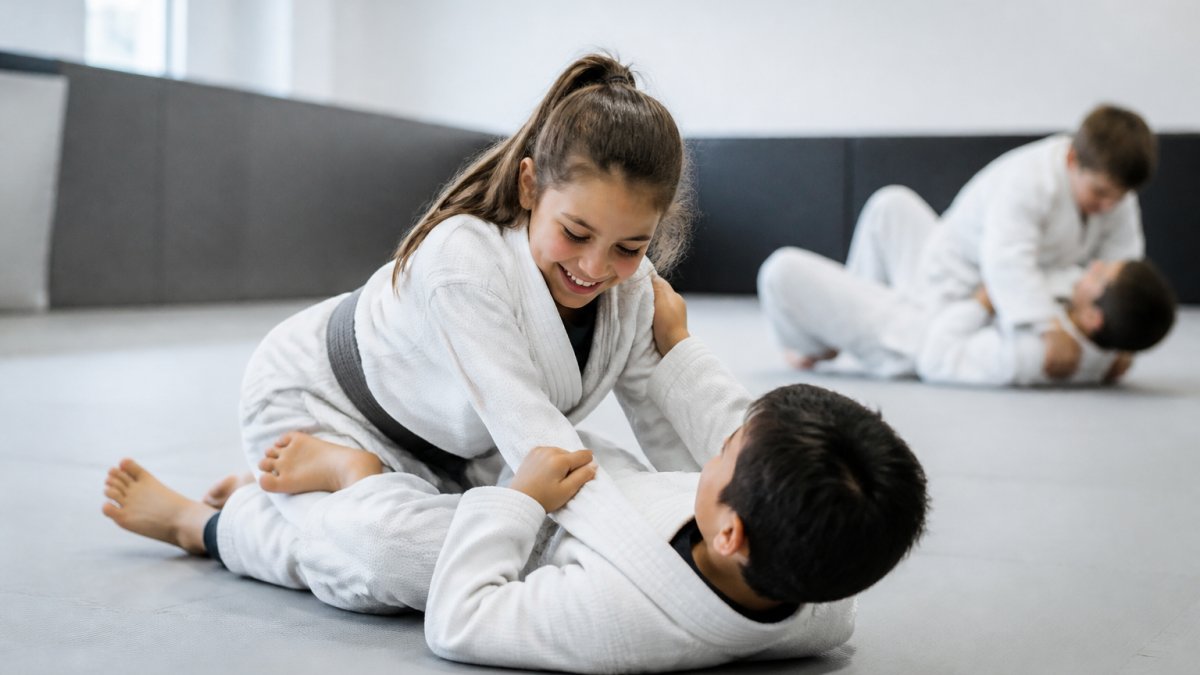
Children also benefit from early training.
Booking Your Free First Class at Evolve Jiu Jitsu & Muay Thai
The best way to judge whether BJJ fits your self-defense goals is to try it.
Pick a class time, arrive a few minutes early, and tell the instructor you are new. Focus on learning and asking questions rather than trying to win every roll.
Evolve Jiu Jitsu & Muay Thai is ready to help you start your training. Book your free trial class today.
Frequently Asked Questions
What are the downsides of Jiu-Jitsu?
The main downsides are time and risk. Real proficiency usually takes years, and a student who trains only a few times a month may not build reliable reflexes. Ground-focused training also carries injury risk, such as sprains and joint strain, especially in sparring. Standing threats, multiple attackers, and weapons are not the core focus of BJJ, so students should pair it with awareness training, de-escalation skills, and, where appropriate, striking practice. Choosing a school with a structured curriculum helps manage these tradeoffs.
Will BJJ help me in a street fight?
BJJ can help if a fight goes to the ground or if you need to control an opponent, escape a bad position, or hold someone until help arrives. It is less useful at the start of a confrontation, when strikes and the first exchange matter most. Good self-defense training emphasizes avoiding the fight, leaving when you can, and using the fewest force options necessary. BJJ works best as one part of a broader skill set rather than a complete answer on its own.
Is BJJ harder than boxing?
Difficulty depends on what you mean. BJJ has a steep technical learning curve because positions, escapes, and submissions require sustained practice before they feel natural. Boxing demands strong conditioning, timing, and the ability to take punches while sparring, and beginners often find the pace and contact tough early on. Many people find boxing easier to pick up quickly, while BJJ tends to reward long-term consistency. Trying a free first class at a reputable gym can help you judge which fits your goals and physical condition.
Is Brazilian jiu-jitsu effective if the other person is bigger or stronger?
BJJ is built around leverage and technique, so a smaller practitioner can often control or escape a larger opponent who relies on strength. However, technique does not remove size and strength differences entirely. Larger, stronger opponents can still injure you, and skill takes time to develop. Training with partners of varied sizes, including live sparring at controlled intensity, helps students test what works against resistance and build realistic expectations.